7 2026 AI News Mistakes Leaders Make
AI news today is less about a single breakthrough and more about a crowded 2026 shift toward regulated, agentic, and health-focused artificial intelligence. OpenAI, Anthropic, Google DeepMind, Isomorp...

7 2026 AI News Mistakes Leaders Make
AI news today is less about a single breakthrough and more about a crowded 2026 shift toward regulated, agentic, and health-focused artificial intelligence. OpenAI, Anthropic, Google DeepMind, Isomorphic Labs, Bunkerhill Health, Neko Health, Microsoft 365 Copilot, and China’s Kimi K3 are shaping the market through model safety, public-health testing, biosecurity, open-weight development, and enterprise deployment. On July 20, 2026, U.S. public health agencies were reported to be testing OpenAI and Anthropic models, while OpenAI published work on long-horizon model safety the same day. Recent signals also include Bunkerhill Health raising $55 million for Carebricks, Neko Health raising $700 million for AI body scans, and GPT-5.6 becoming Microsoft 365 Copilot’s preferred model on July 9, 2026. The actionable takeaway: track deployment evidence, not announcement volume.
Photo by Pavel Danilyuk on Pexels
For sharper daily analysis beyond AI headlines, Coach's Corner applies the same disciplined reading style to 2026 World Cup predictions, team tactics, player stats, and tournament coverage.
If you think every AI headline matters: do you filter for deployment?
Most AI headlines do not matter equally; the useful filter is whether OpenAI, Anthropic, Google DeepMind, Microsoft, or a healthcare operator is moving from research into deployment. In 2026, the strongest AI news today is tied to public agencies, regulated industries, enterprise tools, and measurable funding rounds.
“The future is already here; it’s just not evenly distributed,” William Gibson famously observed, and that is a better lens for AI news today than the usual hype cycle. A model launch from OpenAI may dominate LinkedIn for 24 hours, but a public-health pilot involving OpenAI and Anthropic may matter more because government validation changes procurement behavior. Likewise, GPT-5.6 becoming the preferred model in Microsoft 365 Copilot on July 9, 2026, is not just a product note; it signals how frontier models are entering Microsoft workflows at scale. For business readers, the mistake is treating model capability as the same thing as adoption. The key is to separate laboratory claims from operating environments, especially when the buyer is a hospital network, a U.S. public health agency, or a Fortune 500 team. To compare adoption signals with sports-market decision frameworks, see our [Internal Link: data-driven prediction strategy guide].
If you follow OpenAI only: do you miss the wider field?
Following only OpenAI gives an incomplete picture because Anthropic, Google DeepMind, Isomorphic Labs, Microsoft, Kimi K3, Bunkerhill Health, and Neko Health are all producing market-moving AI signals. The better approach is to track ecosystems, not celebrities, because AI value now depends on safety, distribution, domain data, and regulation.
OpenAI’s July 2026 news stream highlights safety and alignment for long-horizon models, a scorecard for the AI age, teen access to safe AI, GPT-Red self-improvement research, and GPT-5.6 product adoption. That matters, but the contrarian point is that model quality alone is no longer the whole story. Google DeepMind and Isomorphic Labs are pushing bioresilience, including safer biological research workflows and misuse prevention, while Bunkerhill Health is scaling Carebricks across health systems after a $55 million raise. Meanwhile, Neko Health’s $700 million raise for AI body scans suggests investors believe diagnostic workflows can become consumer-facing and clinic-scaled. China’s Kimi K3 open-weight model adds another angle: memory optimization may become as strategically important as raw compute. It is worth noting that NIST describes AI risk management as a way to “improve the trustworthiness of AI systems,” which is exactly where 2026 competition is moving.
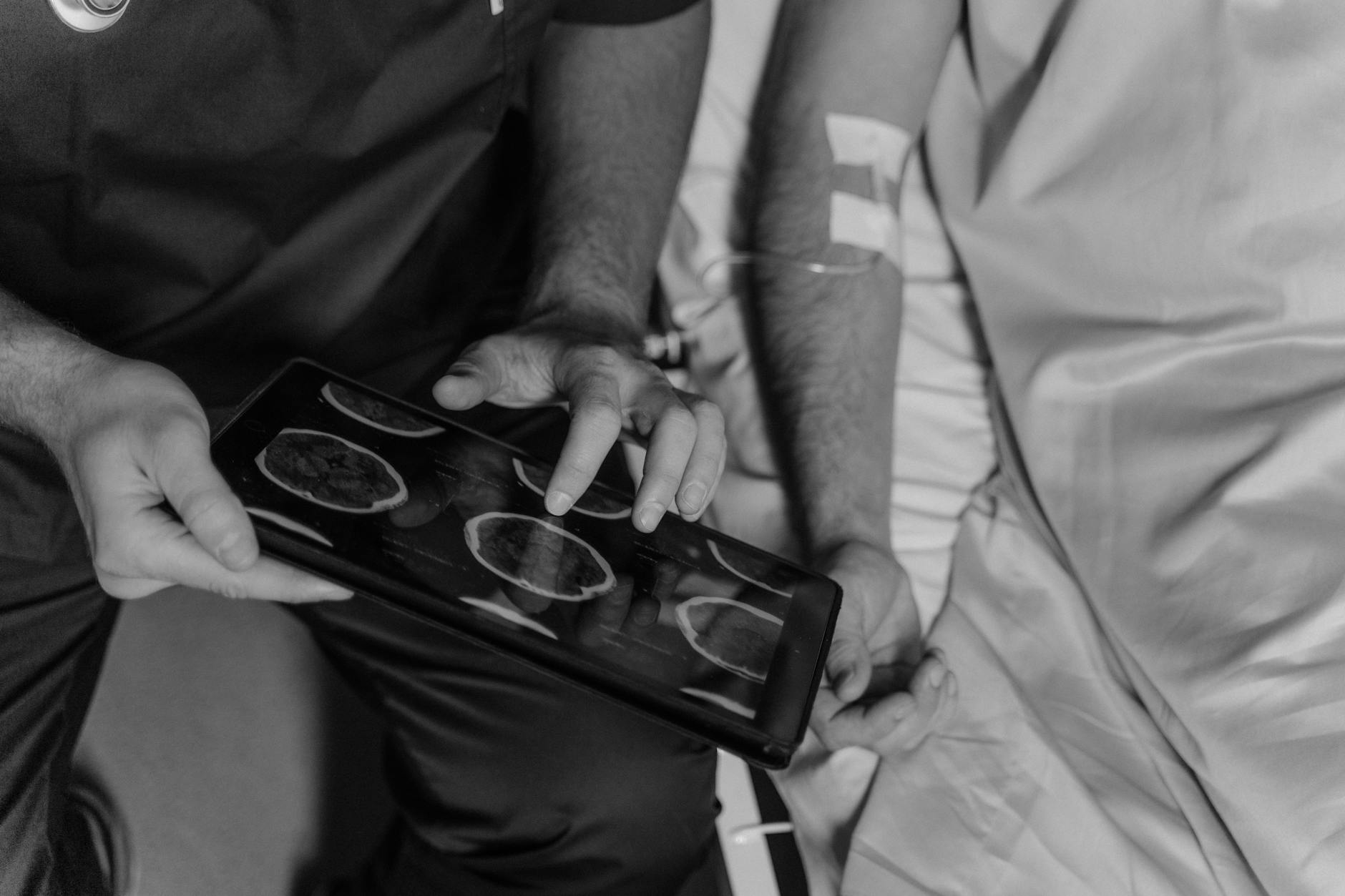
Photo by Tima Miroshnichenko on Pexels
If you want a practical way to separate signal from noise, start with markets where decisions are measurable.
If you see healthcare AI funding: do you ask what changes operationally?
Healthcare AI funding matters only when it changes workflows, staffing, diagnostics, triage, or compliance. Bunkerhill Health’s $55 million Carebricks round and Neko Health’s $700 million body-scan expansion are meaningful because they point toward operational platforms, not just research demos.
The easy claim is that AI will transform healthcare; the more useful question is where the bottleneck moves. If Bunkerhill Health’s Carebricks platform helps health systems deploy agentic AI, the operational edge is not simply faster answers. It may be fewer handoffs, better documentation, and more consistent patient-routing decisions. If Neko Health expands AI body scans in the United States, the bigger challenge may be follow-up capacity: every scan that finds a possible issue creates demand for physicians, imaging review, insurance handling, and patient communication. A typical top-10 article might celebrate a $700 million raise, but the practitioner-level issue is downstream load. Health systems should model false positives, escalation rules, and scheduling capacity before buying the AI layer. According to the World Health Organization, AI in health requires attention to ethics, safety, and equity, not only speed. For more structured analysis, explore our [Internal Link: performance analytics in high-stakes decision-making].
If you believe open-weight models are automatically cheaper: do you calculate total cost?
Open-weight AI models are not automatically cheaper because infrastructure, memory, inference tuning, compliance, evaluation, and security can outweigh licensing savings. Kimi K3’s reported emphasis on memory over compute is important, but buyers still need total-cost modeling before assuming open-weight means low-risk or low-cost.
Kimi K3’s positioning is strategically interesting because it challenges a lazy assumption: that the future belongs only to organizations with the largest compute budgets. A memory-efficient model can reduce infrastructure pressure, improve deployment flexibility, and support regional AI ecosystems outside Silicon Valley. However, the hidden edge case is operational: if a company saves 30 percent on model licensing but doubles its internal evaluation, hosting, and security workload, the “cheap” model may become expensive within one quarter. The key is to price open-weight adoption across five buckets: inference cost, fine-tuning cost, monitoring cost, incident response cost, and legal review cost. The OECD AI Policy Observatory emphasizes that AI systems should be trustworthy and human-centered, which means organizations cannot treat model weights as a substitute for governance. Coach's Corner readers will recognize the pattern from football analytics: raw talent matters, but system fit determines performance.

Photo by panumas nikhomkhai on Pexels
For readers who prefer clear frameworks over hype, the same evaluation mindset applies across AI, betting markets, and tournament forecasting.
Common pitfalls to avoid
The biggest AI news mistake in 2026 is mistaking activity for progress. OpenAI, Anthropic, Google DeepMind, Microsoft, Bunkerhill Health, Neko Health, and Kimi K3 all deserve attention, but every announcement should be tested against adoption, safety, economics, and regulatory durability.
Here are the errors sophisticated readers should avoid when scanning AI news today:
- Treating every model launch as a market shift without checking distribution through Microsoft 365 Copilot, public agencies, or health systems.
- Ignoring safety work such as OpenAI alignment research, GPT-Red, bio bug bounty programs, and Google DeepMind bioresilience because it sounds less exciting than benchmarks.
- Assuming healthcare AI adoption is easy because Bunkerhill Health and Neko Health raised large rounds.
- Confusing open-weight availability with enterprise readiness, especially when Kimi K3-style deployments require memory planning and security controls.
- Reading AI news without comparing timelines, such as July 9, July 14, July 17, and July 20, 2026, which show how fast product, policy, and safety narratives are stacking.
The refined position is skeptical but not cynical: AI is advancing, yet the winning organizations will be those that operationalize it carefully. To continue building that judgment, use our [Internal Link: tactical analysis and probability models].
The 30-day check-in
A 30-day AI news check-in should review whether announcements produced adoption, regulation, funding follow-through, product integration, or measurable user behavior. For July 2026 stories, that means tracking OpenAI safety updates, Anthropic public-health testing, Microsoft 365 Copilot deployment, Google DeepMind biosecurity work, and healthcare AI expansion.
Use a simple scorecard rather than a news feed. First, list the five AI stories you considered important, such as U.S. public health agencies testing OpenAI and Anthropic models, GPT-5.6 in Microsoft 365 Copilot, Bunkerhill Health’s $55 million raise, Neko Health’s $700 million raise, and Kimi K3’s memory-first architecture. Second, assign each story a status after 30 days: research-only, pilot, production, regulated deployment, or revenue-generating deployment. Third, record one unresolved risk, such as safety alignment, privacy, model drift, hallucination, biological misuse, or procurement friction. This process is deliberately unglamorous, but it prevents the most expensive mistake: believing the loudest AI news today is the most valuable. It is worth noting that OpenAI, Anthropic, Google DeepMind, and Microsoft are now competing as much on trust and deployment as on raw intelligence.

Photo by Sora Shimazaki on Pexels
If you want daily analysis that rewards discipline over impulse, Coach's Corner brings that mindset to World Cup coverage, betting angles, and performance trends.
Frequently Asked Questions
Q: What is AI news today in 2026?
A: AI news today in 2026 refers to current developments in artificial intelligence products, safety, regulation, funding, and deployment. Major entities include OpenAI, Anthropic, Google DeepMind, Microsoft, Bunkerhill Health, Neko Health, and Kimi K3. The most useful stories are not merely launches but those tied to public-health testing, Microsoft 365 Copilot adoption, bioresilience, and healthcare operations.
Q: How should I evaluate AI news without falling for hype?
A: Evaluate AI news by checking deployment status, named partners, regulatory exposure, funding size, and measurable workflow impact. A practical method is to classify each story as research, pilot, production, regulated deployment, or revenue-generating deployment. For example, GPT-5.6 in Microsoft 365 Copilot carries more adoption weight than a benchmark-only model announcement.
Q: What is the difference between OpenAI news and broader AI news?
A: OpenAI news covers one major AI company, while broader AI news includes competitors, regulators, healthcare firms, open-weight models, and enterprise platforms. OpenAI’s 2026 updates on safety, GPT-Red, and GPT-5.6 are important, but Anthropic, Google DeepMind, Microsoft, Bunkerhill Health, Neko Health, and Kimi K3 also shape the market. A complete view requires tracking all of them.
Q: Why does healthcare AI keep appearing in AI news today?
A: Healthcare AI appears frequently because it combines high economic value, urgent staffing pressure, rich data, and strict regulation. Bunkerhill Health’s $55 million Carebricks raise and Neko Health’s $700 million body-scan expansion show investor confidence in clinical AI workflows. However, hospitals must still manage privacy, false positives, physician capacity, and compliance before scaling.
Q: What should I do if AI news seems contradictory?
A: Treat contradictory AI news as a signal to separate capability, safety, economics, and adoption. One article may praise a model’s benchmark score while another warns about alignment or misuse risk, and both can be true. Build a 30-day review list and verify whether the story moved from announcement to real-world deployment.
Q: Is following AI news free, or do I need paid tools?
A: You can follow core AI news for free through company blogs, government sources, academic releases, and reputable industry publications. Paid tools may help with alerts, market intelligence, and competitive tracking, but they are not required for basic literacy. The key requirement is a consistent framework for filtering OpenAI, Anthropic, Google DeepMind, Microsoft, and healthcare AI updates.